
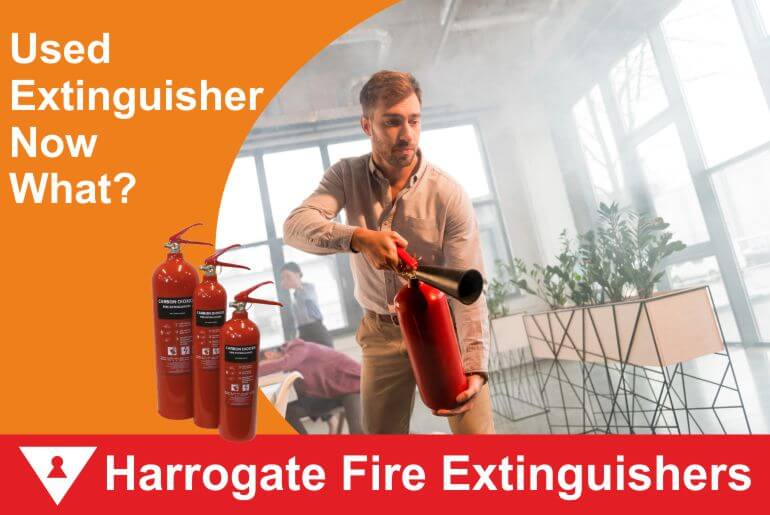
What Should a Business Do After a Fire Extinguisher Has Been Used?
Even a relatively minor workplace fire can result in a fire extinguisher being discharged. The immediate emergency may be dealt with successfully, but businesses then face another important question: what should happen to the extinguisher afterwards?
A common mistake is to return a partially used extinguisher to its normal position because it still appears to contain extinguishing agent. In other cases, discharged equipment is left in a storeroom while somebody waits for the next scheduled service visit.
Neither approach provides reliable fire protection.
For commercial premises in Harrogate, having a clear procedure for dealing with used fire extinguishers can help ensure protection is restored promptly following an incident.
Do Not Put a Used Extinguisher Back Into Service
Once a fire extinguisher has been operated, it should not simply be returned to its mounting point.
This applies even when only a small amount of extinguishing agent appears to have been discharged.
Operating the extinguisher can affect its pressure and internal condition. There is no guarantee that a partially discharged unit will operate correctly if another emergency occurs.
The extinguisher should therefore be identified as having been used and removed from normal service until it has been professionally assessed.
Report the Incident Immediately
Employees should know who to inform whenever an extinguisher has been operated.
Depending on the organisation, this may be:
- A facilities manager
- Fire safety manager
- Health and safety manager
- Building manager
- Business owner
- Designated responsible person
Reporting the incident quickly allows replacement fire protection to be arranged rather than leaving an area without suitable coverage.
The circumstances surrounding the discharge should also be recorded.
Arrange Professional Assessment
A competent fire extinguisher engineer should assess equipment following use.
Depending on the extinguisher, its condition and the extent of the discharge, appropriate action can then be determined.
The important point for businesses is not to attempt to make this decision themselves based purely on appearance.
An extinguisher may look perfectly normal externally while no longer being ready for reliable operation.
Restore Fire Protection Promptly
Removing an extinguisher creates a temporary gap in the building’s fire protection arrangements.
This is particularly important where the extinguisher protected a specific risk, such as machinery, electrical equipment or another higher-risk area.
Businesses should therefore arrange appropriate replacement coverage without unnecessary delay.
In larger premises, it is also worth checking whether other extinguishers have been moved following the incident. During emergencies, equipment can sometimes be taken from nearby locations but never returned afterwards.
Investigate Why the Extinguisher Was Needed
Using an extinguisher indicates that a fire incident has occurred, even if it was small and successfully contained.
The business should consider what caused it.
Was faulty electrical equipment involved?
Did a working process create an ignition source?
Was combustible material stored incorrectly?
Could changes reduce the chance of the same incident happening again?
A minor fire can provide an important warning about a developing workplace risk.
Review the Fire Risk Assessment
Depending on the circumstances, the incident may also justify reviewing the fire risk assessment.
A fire can expose hazards that were previously underestimated or demonstrate that working practices have changed.
The review might identify a need for:
- Changes to working procedures
- Different storage arrangements
- Additional staff instruction
- Revised extinguisher provision
- Improved housekeeping
- Changes to other fire precautions
The objective should be to learn from the incident rather than simply replace the extinguisher and carry on as before.
Record What Happened
Accurate documentation is an important part of commercial fire safety management.
Businesses should retain relevant information about the incident, including which extinguisher was used and what subsequent action was taken.
Where equipment is replaced, servicing and asset records should also be updated.
For organisations operating several premises, good records make it considerably easier to maintain an accurate picture of fire safety equipment across the estate.
Make Sure Employees Understand the Procedure
Employees do not need detailed technical knowledge about extinguisher maintenance, but they should know what to do following a discharge.
A simple workplace procedure can make clear that used equipment must be reported immediately and must not simply be placed back on the wall.
This avoids uncertainty and helps ensure fire protection is restored quickly.
Harrogate Fire Extinguishers
Harrogate Fire Extinguishers supplies, installs and services portable fire extinguishers for commercial premises throughout Harrogate and the surrounding areas.
If an extinguisher has been discharged, damaged or requires replacement, our experienced engineers can assess your equipment and help restore suitable fire protection to your premises.
We also provide scheduled commercial extinguisher servicing and advice for businesses looking to review their existing provision.
Harrogate Fire Extinguishers
Tel: 01423 400456
Email: [email protected]
Website: harrogatefireextinguishers.co.uk